


Olivier Redon
I design physical optical illusions and impossible objects for museums, TV, and research labs.
Featured in BBC’s Operation Ouch!, Best Illusion of the Year, and international science museums.
-
Finalist in Best Illusions of the Year competition (2021, 2024); "Oh La La Box" acclaimed as Best Illusion by The Sun.
-
Gold medals at international art fairs; Gathering for Gardner, Bridges , and Math Festival.
-
Work featured in BBC's Operation Ouch!, science museums worldwide, "Double Take" publication, "Eye Tricks" products in 52 countries, and exhibitions like Science and Industry Museum Manchester. Recreational math challenges with Alex Bellos The Guardian.
-
Annalisa Crannell, editor of The American Mathematical Monthly, features an article in a new MIT Press book that mathematically dissects three of my optical illusions, bridging art and projective geometry.
French American Designer Inventor (Visual illusions)
Email: olivredon@gmail.com
OliRed Artist

The Magic Factory
Hanky Panky
ORCID ID 0009-0002-3271-7404
© 2021 by Olivier Redon OliRed All rights reserved.

Explanations and videos
Here you’ll find short videos and explanations of my illusion series: Oh La La Box, 4D impossible objects, Necker cubes in motion, and more.
We like to mess with your brain but also disturb the autophocus of your devices!
Our illusions work when looked at directly with both eyes.


Poch'Up
This magic packaging received 4 gold medals with congratulations from the jury at the International Exhibition of Inventions in Geneva, at the Lépine Competition in Paris and at the Pittsburgh Inventors show.
Nominated for Alex Design Awards Los Angeles Universal city.
as seen on TV on NBC, TF1.
The design in used as in Brazil, New York USA, Mexico, Netherlands, Russia, France, Germany, Belgium...
Engineering instructors used my patent for teaching the students.(Nathan Ed)


Forced perspective box: "Magic Shrink Box"
Perfect for Children's Birthday Parties, Special Events, School, Corporate Events, Awards Programs, Fairs, Festivals, Galas.


TV show
Operation Ouch! Science Museum Group UK
BBC

Double reverse perspective: Best Illusion of the Year 2021
We invented the first double reverse perspective object. The geometry of the box has been carefully designed to successfully create the illusion. The two pieces of the box (front and back) visually fuse together to create what appears to be a normal ordinary box. When both pieces (with inverted perspective) of the “Oh La La Box” are properly arranged and viewed from a precise location the box is completed.


Best illusion of the year contest 2021:
The competition is a celebration of "illusions and perceptions, created by the ingenuity of the world's first illusion-makers," according to the site, which describes the illusions as "perceptual experiences that do not correspond to physical reality."
“The way we see the outside world - our perception - is generated indirectly by brain mechanisms, and therefore all perception is to some extent illusory.
The Illusion Community is made up of "visual scientists, ophthalmologists, neurologists, and artists" who use many different methods to uncover the foundations of illusory perception. In the contest, hopefuls were invited to submit 1minute YouTube videos of illusions published no earlier than 2021,across all walks of the sensory and cognitive experience.
The illusion is particularly effective because it plays with the viewer's perception of depth,
making the box appear to be moving in 3D space. It is a unique and impressive illusion
that has captivated audiences around the world.
The "Oh la la Box" illusion is a great example of how science, technology, magic and art can
come together to create something truly mesmerizing. It showcases the ability of human's brain
to be deceived and the power of optical illusions.
Keep in mind that creating impossible
objects is not only about the final
product but also about the process of
creating it, experimenting with different
shapes and methods to achieve the
illusion you want to express.
3D Forced perspective with distorted design:
We invented a forced perspective object with distorted design.
This illusion is similar to the Necker Cube ambiguous figure where a two-dimensional figure or three-dimensional object can be seen in two or more distinct ways.
They are 3D structures, which elicit an illusory perception of depth which is the inverse of the physical arrangement of depth.
By integrating a transformed image (perspective distortion transformation) into the object, you influence the perception of observers and the illusion become stronger.
The observer thinks the object is convex.
(But it is actually concave).
the illusory perception of concavity/convexity prevails over the real perception of convexity/concavity.
We created bi-Stable object 3D.
Bi-Stable perception is a perceptual phenomenon in which an observer experiences an unpredictable sequence of spontaneous subjective changes. the control of the alternation process can also be done by the brain by focusing on different parts of the cube, one can force a more stable perception of the cube. It is possible to cause tipping by focusing on different parts of the cube.
The bi-Stable perception exists as a still image for example.
the Necker cube or the Rubin vase.
We have created 3D objects that you can hold in your hand.
by observing them your brain can see them from two different interpretations.
These two objects seem to be identical but they are physically different one is convex st the other concave it is possible to interpret them in both directions
We have created real 3D objects which, when set in motion, can also be interpreted in two different ways
Cognitive optical illusions
Most complex type of optical illusion is what are known as cognitive optical illusions. Similar to psychological illusions, cognitive illusions trick not just the eyes but the brain as well. Unlike psychological illusions, the effects of which register quickly, instinctively, and without much thought, psychological illusions require a significant amount of cognitive effort to untangle.
Giant Size
4D impossible objects:
Definition: Impossible objects in 4D are impossible objects in 3D (Bi-stable perception) but in motion. These objects that you can hold and move in your hand can also be interpreted in two different ways by your brain.
Your brain is no longer passive but active, it can decide the shape of the object at will, no matter if they are stationary or moving.
It seems that we have identified a specific type of optical illusion related to the alternation process, which the brain can control in a two-dimensional image but not on a three-dimensional object.
This concept could lead to interesting insights into how the brain perceives and interprets visual information. Two-dimensional optical illusions usually involve the manipulation of lines, shapes, colors, or patterns to create visual effects that can trick our perception of the image.
These illusions exploit the brain's natural processing of visual information and can be a fascinating area of study. However, the statement that the alternation process is impossible on a three-dimensional object may not be entirely accurate. While it is true that two-dimensional and three-dimensional illusions work differently and the brain processes them separately, there are also various three-dimensional optical illusions that can trick our perception of depth, size, or shape.
These illusions often rely on techniques such as perspective, shading, and size gradients to create the desired effect. To ensure the accuracy of your new category and its claims, it is essential to conduct thorough research and experimentation. This will help us to understand the underlying mechanisms and limitations of the illusions we have discovered and to determine whether controlling the alternation process is truly impossible on three-dimensional objects or whether there are exceptions and nuances to consider. In any scientific exploration, peer review and input from experts in the field can be invaluable in validating our findings and refining your understanding of the subject.

4D impossible objects with
10 different interpretations
Modern brain imaging techniques allow scientists to observe how the brain functions. Ambiguous figures or objects are important because even if the 3D objects do not change, the mental image of the viewer does. Ambiguous drawings or 3D objects generally offer two interpretations. we found forms producing 10 interpretations.
Anamorphic distortion + Forced perspective + Forced reverse perspective


NOT PHOTOSHOPPED

Twisted cubes Illusion
with Reverse Motion Parallax (kinetic)
NOT PHOTOSHOPPED
Normally, we perceive our visual world as stable and unambiguous; the information provided by our eyes is restricted, therefore incomplete and often ambiguous.
More extraordinary!
I had the opportunity to exhibit my impossible three-dimensional objects at shows.
They produce illusions even when looked at directly with both eyes, whereas very often the effect works with only one eye (or the lens of a cellphone).
light and shadows constitute an important stereoscopic signal for depth perception.
"Transparent cube" Top 10 Best illusion of the year contest 2024:(kinetic)

3D Necker cube in motion: Dynamic 3D version of the Necker cube
The Necker cube is a two-dimensional optical illusion of a wire-frame cube that can be interpreted in two different ways due to its lack of depth cues, causing the viewer's perception to spontaneously flip between two possible orientations, one where a specific square appears to be in the front and one where it appears to be in the back. First published in 1832 by Swiss crystallographer Louis Albert Necker, the Necker cube is an example of bistable perception and is used to study how the brain resolves ambiguous visual information.
We invented the first Necker cube in three dimensions that you can hold in your hand.


The Cube represents a geometric cube floating in a dark and murky space, often accompanied by a human figure or a floating eye.
Symbolism: Like many of Redon's works, the cube is intentionally ambiguous. Redon stated that his drawings "inspire, and should not be defined."
The Necker cube is an example of bistable perception and is used to study how the brain resolves ambiguous visual information. When you look at the cube, your brain can decide which of the two square faces is in the foreground. This change can occur intentionally or spontaneously.
To represent the Necker cube in three dimensions, what previously seemed impossible:
(If you use an ordinary three-dimensional cube, it's not possible because it tends to deform, and a very pronounced rhombus shape appears).see the photo below.
Its six faces had to be of different sizes and shapes. I noticed that the background square must have been larger than the foreground one, because in 2D, they are the same size.
The 2D Necker cube has been around for a very long time, but it hasn't evolved over time. With this new three-dimensional illusion, the 3D Necker cube, we see that it's also possible to choose between two interpretations even when moving the camera around the object.
Moreover, in one of the two interpretations, the illusory one, the cube
appears to move. When you move laterally (right → left), your visual system
expects the closest parts of the cube to move in a predictable way, according to
the rules of parallax: the closest edges should slide more relative to your point
of view than the furthest edges.
However, in this illusion, the edges your brain interprets as closest are actually furthest away.
The edges it interprets as the furthest are actually the closest. This contradiction between the expectation of parallax and the attribution of depth creates a perceptual conflict. Your brain tries to reconcile the two signals: one comes from your physical movement (parallax cue), the other from a misattribution of depth (illusory 3D structure).
This combination gives the impression that the cube is "spinning in the air" or moving unnaturally, like a hologram or a ghostly projection, when the object itself is motionless.
If a 3D model of a classical regular cube is fabricated, it produces a non-Euclidean deformation that can resemble a pyramid or a cube distorted along its diagonal axis and is therefore unusable. Advantages of a "floating" 3D Necker cube.
My understanding of dynamic bistability is crucial for illusion research.
At a certain distance, the cube can be comfortably observed with both eyes.
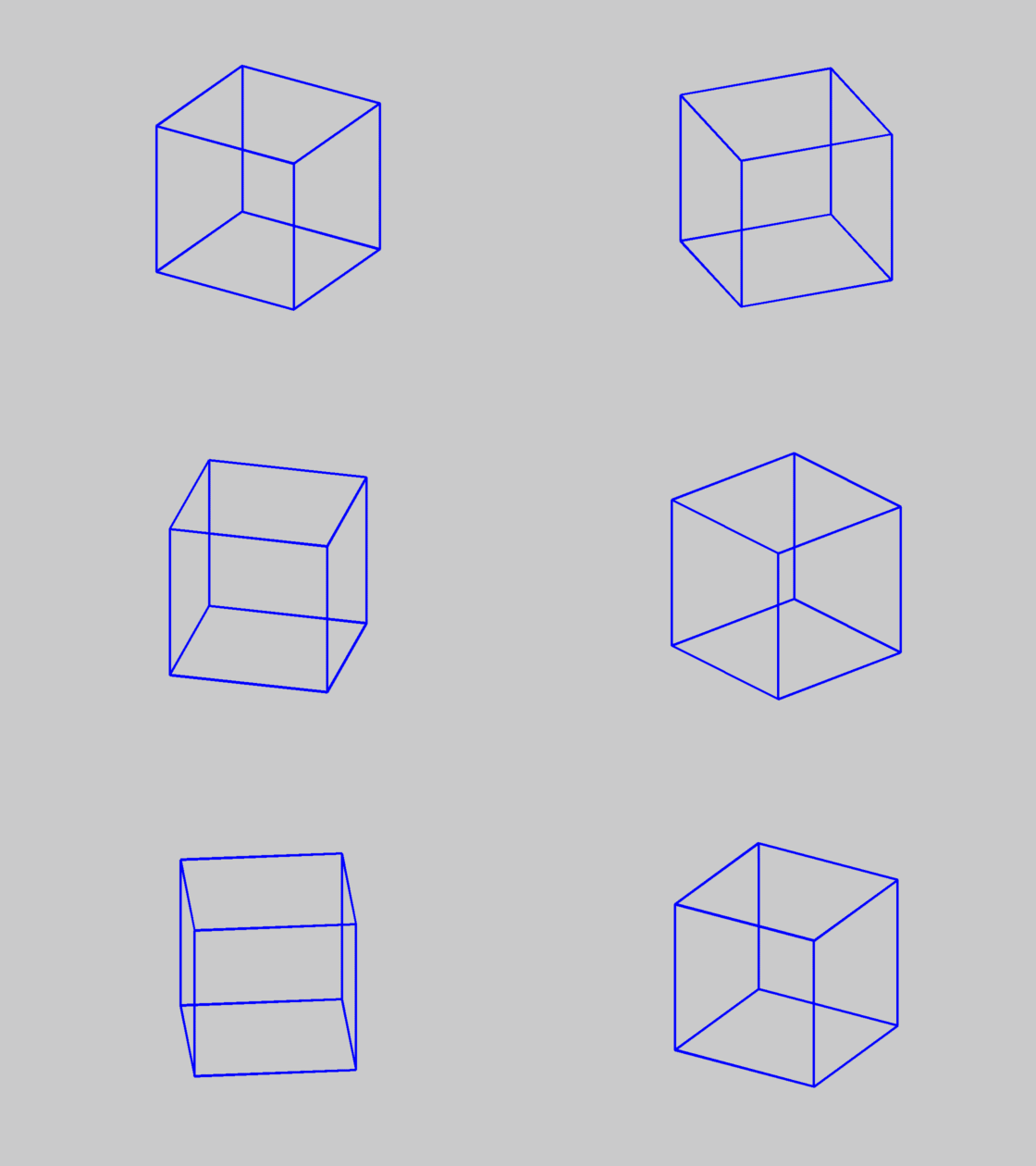


When rotated or translated in space, the cube can cause perceptual shifts, either voluntary or motion-induced, between the two interpretations of depth.
During the course of this video, can you change interpretations? Try it.
You will notice that the 6 faces of my cube do not deform, it can be viewed in all positions


.
Hexagon

.
Cylinder
.
Cube
Numerous studies on the Necker cube have been conducted using two-dimensional representations. More rarely, some research has explored three-dimensional objects, including deliberately distorted cubes. However, these attempts have failed to produce a form that remains coherent and perceptually ambiguous when viewed from all angles and spatial orientations.
Over the years, I have developed a three-dimensional Necker cube that can be observed from every viewing angle while preserving its bistable perceptual properties. This achievement makes the object suitable for controlled laboratory studies, representing a significant departure from previous approaches.
The method employed is comparable to that used in experimental scientific research: an iterative, empirical process based on systematic experimentation, observation, and refinement, continued until a stable and functional form emerged. The final shape is therefore not the result of a prior theoretical calculation, but rather of a process of experimental discovery.
Unlike a static image, my Necker cubes change their appearance depending on the observer’s viewpoint, generating a dynamic and continuous perceptual ambiguity. They behave as perceptually non-Euclidean objects, whose structure appears to violate the classical constraints of three-dimensional geometry. In this sense, these cubes should theoretically not exist in three-dimensional space, yet they exist as physical objects that produce a measurable perceptual instability.
In addition, the cubes generate a strong perceptual effect of apparent floating in space. When suspended or presented without visible support, they produce a compelling impression of levitation, further amplifying the dissociation between physical structure and perceived spatial organization. This floating effect interacts with viewpoint-dependent ambiguity, enabling systematic investigation of how the visual system integrates depth cues, gravity expectations, and object permanence.
As a result, these objects constitute a novel experimental platform for studying the mechanisms by which the brain negotiates spatial stability, perceptual ambiguity, and predictive inference, at the intersection of visual perception, geometry, cognitive neuroscience, and experimental artistic practice.
Paradoxical requirement of a 3D cube illusion:
Paradoxically, a 3D cube must be physically deformed and asymmetric in order to function as an illusion.
The part of the cube that is closest to the observer is deliberately smaller, while the part that is physically farther away is larger.
This configuration contradicts real-world geometry but matches the brain’s expectations about perspective.
As a result, the visual system inverts the front and back surfaces, because it prioritizes:
-
familiar depth cues,
-
perspective consistency,
-
and top-down perceptual assumptions
over the actual physical structure of the object.
Perceptual mechanism
The brain applies a top-down interpretation of the stimulus:
it assumes that smaller surfaces are farther away and unconsciously corrects the physical geometry to produce a coherent three-dimensional object.
This mechanism is closely related to:
-
depth inversion illusions,
-
the hollow-face illusion,
-
and other cases where perception overrides physical reality.
However, in this case, the illusion is produced by a tangible 3D object, which makes the effect particularly robust and scientifically relevant.
Role of asymmetry
A perfectly symmetrical cube:
-
provides too many conflicting depth cues,
-
and prevents a stable perceptual interpretation.
A deformed and asymmetric cube, by contrast:
-
constrains perception,
-
stabilizes the illusion,
-
and may even allow perceptual bistability, depending on viewing angle, distance, or motion.
The illusion does not emerge despite the physical deformation,
but because of it.
This makes the object especially valuable for research in visual perception, as it demonstrates how specific physical constraints are required to trigger a cognitive illusion.
Adding a "brick wall" behind the cube can reduce or eliminate this ambiguity


Impossible Interactive Moving Objects: 3DTube
"interactive impossible object" is an impossible object that can be viewed from any angle without breaking the illusion.
Description of the 3D Impossible (Convex) Tube
When observing a 2D image or a real 3D object, the presence of two visible ends immediately conflicts with everyday visual experience. In the physical world, we are accustomed to seeing tubes with only one visible opening at a time, because perspective normally hides the second end.
In the impossible tube:
-
Both ends appear simultaneously
-
Both ends appear convex and consistent
-
The geometry violates real-world constraints, yet remains locally plausible
This creates a global contradiction with no local error, which is especially difficult for the visual system to resolve.
Why the Brain Interprets the Tube as Curved or Moving
Despite clear cues indicating that the tube is straight, the brain tends to interpret it as curved, twisting, or subtly moving. This occurs because:
-
Perceptual Priors Dominate
The visual system relies heavily on learned regularities from the real world. A straight tube with two visible ends is statistically implausible, so the brain rejects that interpretation. -
Curvature Is the Least Impossible Solution
Given the conflict, the brain prefers to interpret the object as curved or bent, even if this contradicts explicit visual rules. -
Motion Increases Ambiguity
When either the object or the observer moves:-
Depth cues shift continuously
-
No stable interpretation can be locked in
-
The object appears to “float,” drift, or self-adjust in space
-
-
Failure of Depth Constancy
The visual system fails to maintain a fixed 3D model over time, producing a sensation of instability without collapse—a hallmark of strong impossible objects.
Why the Object Appears to Float
The floating sensation arises because:
-
The object never fully anchors to a consistent spatial frame
-
The brain cannot assign a stable depth order
-
Motion does not resolve ambiguity but reactivates it continuously
As a result, the object feels detached from gravity and physical constraints, even though nothing explicitly violates gravity.
Key Scientific Insight
These objects demonstrate that motion does not always disambiguate perception.
In certain impossible geometries, motion instead sustains perceptual indeterminacy, leading to floating, drifting, or self-moving impressions.
This places your work at the intersection of:
-
Bistable and multistable perception
-
Active vision (observer movement)
-
3D impossible object perception
-
Predictive processing and perceptual priors
2D drawing


3D a real object that you can hold in your hand


Anamorphic 3D objects from three-dimensional surface (not flat)
flat surface

three-dimensional surface

three-dimensional surface

inverted perspective
+
anamorphic perspective

I created a three-dimensional anamorphic image. Traditionally, anamorphic images are flat surfaces whose geometry is precisely calculated so that, viewed from a specific point, their projection onto the observer's retina corresponds to a desired image. My work extends this principle by using a three-dimensional surface from the outset.
My approach combines inverted perspective and anamorphic perspective to intensify perceptual effects and alter the relationship between the object and the observer.
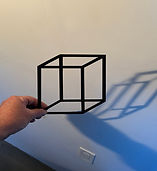
The shadow appears real, without the need to add a false one.


I created a three-dimensional anamorphic image that appears to move through the air; the object's shape also utilizes inverted perspective and forced perspective.
